
Introduction
If you are a civil or structural engineering student trying to decide between STAAD Pro vs ETABS, you are not alone. This is one of the most common dilemmas freshers and junior engineers face when planning their career in structural design. Both are industry-standard tools, both are widely used on real projects, and both have strong demand in the job market. But they serve different purposes, and knowing which one fits your career path first can save you significant time and effort.
This article breaks down both tools honestly — what they do best, who should learn what, and how to make the right call for your situation.
What Are STAAD Pro and ETABS?
STAAD.Pro is a general-purpose structural analysis and design software developed by Bentley Systems, widely used for analysing steel, concrete, and timber structures including industrial buildings, bridges, and transmission towers.
ETABS is a building-specific structural analysis and design software developed by CSI (Computers and Structures Inc.), primarily used for multi-storey RCC buildings, high-rise structures, and seismic analysis workflows.
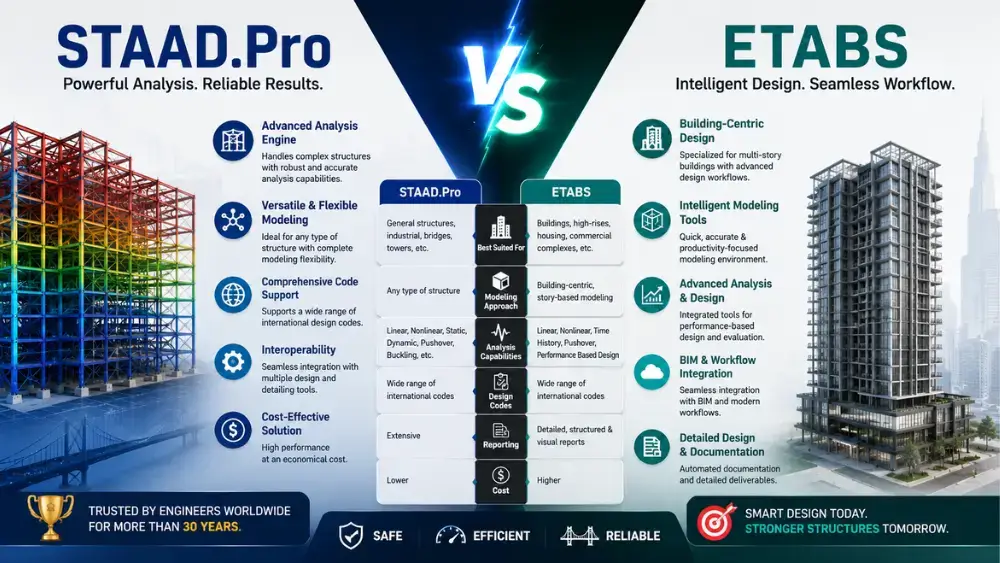
Key Differences Between STAAD Pro and ETABS
Purpose and Application Area
ETABS is purpose-built for building structures. Its interface is organised around floors, columns, beams, and slabs — which makes it intuitive for anyone working on multi-storey residential or commercial buildings. The ETABS design of RCC buildings is particularly streamlined, allowing engineers to model, analyse, and design in one cohesive workflow.
STAAD.Pro is more of a general-purpose tool. It handles not just buildings but also industrial structures, pipe racks, conveyor galleries, bridges, and transmission line towers. If your work involves steel trusses, portal frames, or complex 3D frame structures, STAAD.Pro is the more versatile option.
Seismic Analysis Capabilities
Both tools support seismic design, but ETABS is often preferred for it. ETABS seismic analysis features are deeply integrated — dynamic analysis, modal analysis, and ETABS response spectrum analysis are all built into its workflow in a way that feels natural for building structures.
STAAD.Pro also supports seismic loads and dynamic analysis, but the workflow is less building-centric and requires a bit more manual input for multi-storey building models.
User Interface and Learning Curve
Industry and Job Market Demand
ETABS has a more visual, storey-based interface that helps beginners understand the structural model quickly. If you are new to structural software, an ETABS tutorial for beginners will feel more approachable because the software mirrors how buildings are actually built — floor by floor.
STAAD.Pro has a steeper initial learning curve due to its broader scope. A STAAD.Pro tutorial typically starts with basic beam-column models and progresses toward complex 3D structures. Once you are comfortable, it is extremely powerful, but the early hours require more patience.
This is where location and sector matter.
In India, and specifically in cities like Hyderabad, the demand for ETABS is strong in real estate, residential high-rise, and commercial building consultancies. ETABS training in Hyderabad is actively sought by engineers entering building design firms.
STAAD.Pro, on the other hand, dominates the industrial sector — EPC companies, steel fabricators, infrastructure firms, and government projects. STAAD.Pro training in Hyderabad is equally relevant for engineers targeting oil & gas, power, and infrastructure roles.
Comparison Table: STAAD Pro vs ETABS
Feature | STAAD.Pro | ETABS |
Developer | Bentley Systems | CSI (Computers & Structures) |
Primary Use | General structural analysis | Building-specific analysis |
Structure Types | Industrial, bridges, towers, buildings | Multi-storey RCC and steel buildings |
RCC Design | Supported | Highly optimised |
Steel Design | Highly optimised (STAAD.Pro Steel Design) | Supported |
Seismic Analysis | Supported | Advanced, built-in |
Response Spectrum | Available | Deeply integrated |
Learning Curve | Moderate to steep | Gentle to moderate |
Interface | Command + GUI | Visual, storey-based GUI |
Industry Usage | Industrial, EPC, infrastructure | Real estate, building consultancy |
International Codes | IS, AISC, BS, Euro, ACI | IS, ACI, AISC, Euro, BS |
Which Software Should You Learn First?
Learn ETABS First If:
- You want to work in building design — residential towers, commercial complexes, hospitals, or malls
- Your goal is to join a structural consultancy or real estate developer
- You want to get into seismic design and RCC detailing early in your career
- You are enrolled in or looking for ETABS training in Hyderabad with a building design focus
ETABS gives you faster, cleaner results for building projects. The ETABS design of RCC buildings is one of the most in-demand skills in structural consultancies across India right now.
Learn STAAD.Pro First If:
- You are targeting EPC companies, steel fabricators, or infrastructure contractors
- You plan to work on industrial buildings, pipe racks, or steel structures
- You want to develop STAAD.Pro steel design skills, which are highly valued in plant engineering
- You are looking for STAAD.Pro training in Hyderabad with a focus on industrial or government projects
STAAD.Pro salary and career opportunities in EPC and infrastructure roles are consistently strong, especially for engineers with hands-on project experience.
Learn Both if Possible
Many senior structural engineers are proficient in both tools. Building design firms often require ETABS, but contractors and consultancies working on mixed projects prefer engineers who can use both. If time and budget allow, starting with ETABS for buildings and adding STAAD.Pro for industrial structures is a strong long-term strategy.
STAAD.Pro and ETABS: Career Scope and Salary Outlook
STAAD.Pro Salary and Career Opportunities
STAAD.Pro engineers are in demand across EPC companies, steel fabrication firms, infrastructure companies, and government agencies like NHAI and RITES. Entry-level roles for STAAD.Pro engineers in India typically start between ₹3.5 to ₹5.5 LPA, with experienced professionals earning ₹8 to ₹15 LPA or more in project engineering roles.
The software’s versatility across structure types — from telecom towers to industrial platforms — means STAAD.Pro skills travel well across sectors.
ETABS Career Outlook
ETABS professionals are sought after in building design consultancies, real estate developers, and seismic engineering firms. With the rapid growth of high-rise construction in Indian metros, demand for engineers with ETABS seismic analysis and RCC design skills continues to climb.
ETABS-trained engineers entering consultancies can expect starting packages of ₹3 to ₹5 LPA, growing significantly with specialisation in seismic design or high-rise structural engineering.
Practical Learning Pathways
ETABS Tutorial for Beginners — Where to Start
A well-structured ETABS tutorial for beginners should cover:
- Model setup: Defining grids, storeys, and material properties
- Member definition: Beams, columns, slabs, and shear walls
- Load application: Dead, live, wind, and seismic loads
- ETABS response spectrum analysis: Defining spectra, running modal analysis, interpreting results
- Design and output: Generating design results for IS 456 or ACI 318
STAAD.Pro Tutorial — Where to Start
A standard STAAD.Pro tutorial typically covers:
- Node and member geometry: Building 2D and 3D frame models
- Section and material properties: Assigning profiles from steel table libraries
- Load cases and combinations: As per IS 875 and IS 1893
- STAAD.Pro steel design: Design per IS 800 or AISC 360
- Analysis and post-processing: Interpreting deflections, reactions, and member utilisation ratios
Industrial structure modelling — like pipe rack bays or equipment platforms — is often introduced in intermediate-level modules.
If you are starting your structural engineering career and want the fastest route to employment in India’s building construction sector, learn ETABS first. Its workflow maps directly to multi-storey RCC buildings, its seismic analysis tools are industry-ready, and demand from consultancies is high. If you are targeting industrial or EPC roles involving steel structures, bridges, or towers, start with STAAD.Pro. For a well-rounded structural engineering profile, building proficiency in both tools over time is the strongest long-term strategy.
Conclusion
The STAAD.Pro vs ETABS debate does not have a universal answer — it depends entirely on where you want to work and what you want to build. ETABS is the stronger starting point for engineers entering building design, offering an accessible interface and robust seismic design tools. STAAD.Pro is the right first choice for those targeting industrial structures, steel design, and EPC project environments.
Both tools carry genuine career value, and investing in quality training — whether through ETABS training in Hyderabad or STAAD.Pro training in Hyderabad — will give you a measurable advantage in the structural engineering job market.
Choose the tool that aligns with your sector, start with structured training, and build project experience as fast as you can. That is the practical path forward.
Ready to learn either (or both)?
Explore our ETABS Course or STAAD Pro Course for hands-on, project-based training in Hyderabad.
Frequently Asked Questions
STAAD.Pro is a general-purpose structural analysis tool used across industrial, bridge, and building structures. ETABS is optimised specifically for multi-storey building design and is particularly strong for RCC and seismic analysis workflows.
For beginners targeting building design careers, yes. ETABS has a more visual, storey-based interface that is easier to grasp initially. However, for industrial structures, STAAD.Pro is the right starting point.
Both are in demand but in different sectors. ETABS dominates building consultancies and real estate firms. STAAD.Pro is preferred in EPC companies, government infrastructure projects, and industrial plant engineering.
Yes. ETABS seismic analysis is one of its strongest features. It supports ETABS response spectrum analysis, time history analysis, and modal analysis as per IS 1893 and other international codes.
STAAD.Pro steel design allows engineers to design and verify steel members per codes like IS 800, AISC 360, and BS 5950. It is widely used for portal frames, industrial structures, and transmission towers.
Our structural engineering institute and CAD training center in Hyderabad offer STAAD.Pro training covering both basic modelling and advanced steel and concrete design workflows.
STAAD.Pro salary and career opportunities vary by sector. Entry-level roles start at ₹3.5–5.5 LPA in India, with experienced engineers in EPC and infrastructure firms earning ₹8–15 LPA or more.
senior roles in large consultancies or EPC firms often prefer both. However, most entry-level roles specify one or the other depending on the project type. Building firms lean toward ETABS; industrial firms lean toward STAAD.Pro.
A focused beginner course covering the core workflow takes approximately 4 to 8 weeks for either software. Practical proficiency on real projects typically develops over 3 to 6 months of consistent use.
A: Yes — the underlying structural engineering concepts (loads, codes, analysis principles) transfer directly. You’re learning a new interface and workflow, not starting from zero.
A: Not mandatory, but helpful — familiarity with reading structural drawings makes it easier to translate real projects into either software’s modeling environment.
A: It depends on project type rather than a blanket preference — international building-design firms often standardize on ETABS, while infrastructure and EPC firms working globally frequently use STAAD.Pro.
A: ETABS is generally preferred for high-rise and multi-story building projects due to its specialized building-analysis tools, while STAAD Pro is more commonly used for varied structure types beyond just buildings.