



CATIA Training Institute in Hyderabad
Industry-Aligned CATIA V5 Course with Certification & Placement Assistance
CAD Center Hyderabad offers an in-depth understanding of one of the most advanced CAD tools used in the global design and manufacturing industries. Whether you’re a mechanical engineer, product designer, or student, learning CATIA equips you with powerful modeling and drafting capabilities.
The course helps Students and Professionals master the software’s vast functionalities—from sketching to surface modeling.
Course Structure: What You Will Learn in a CATIA Course
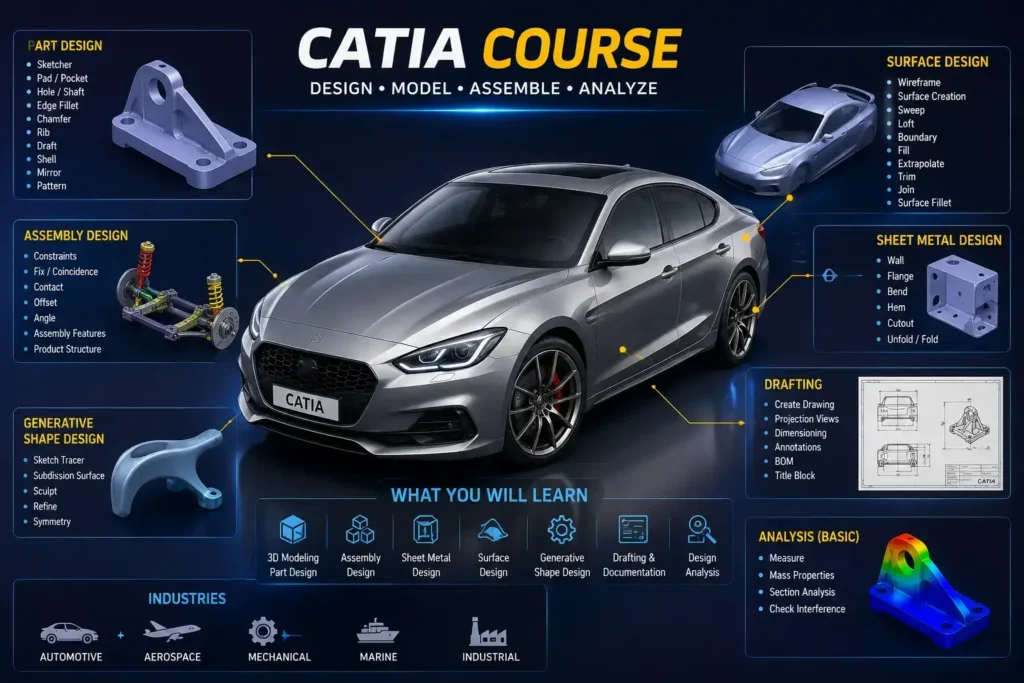
The CATIA course is organized into structured modules that build a strong foundation before advancing into complex modeling and simulation tasks.
- CATIA V5 fundamentals: sketching, part design & assemblies
- Surface modeling & advanced part design
- Sheet metal design
- Generative structural analysis basics
- Drafting & technical documentation
- Real industry-style Aerospace & Automotive design projects
Our Advanced Modules and Topics
Module | Key Topics Covered |
Introduction to CATIA | Software interface, file types, design tree, toolbars, workspace configuration |
Sketcher Workbench | 2D geometry, constraints, profiles, axes, and relations |
Part Design | Solid modeling, pads, pockets, fillets, ribs, and shell features |
Assembly Design | Bottom-up and top-down assemblies, constraints, joints, exploded views |
Drafting Workbench | Generating 2D views, dimensioning, section views, annotations |
Wireframe & Surface Design | Curves, extruded surfaces, sweep, split, trim, and surface analysis |
Sheet Metal Design | Walls, flanges, bends, unfolding, punch operations |
Real-Time Projects | End-to-end modeling of components and assemblies based on real engineering drawings |
Each module is supported by hands-on practice, so learners can gain real-world experience in using the tool efficiently.
Who Should Take This Course
- Mechanical, Aerospace & Automotive engineering students
- Working professionals in product design & manufacturing
- Anyone preparing for CATIA-based design roles in Aerospace, Automotive
or Industrial Design industries
Core Skills You Gain From a CATIA Course
Enrolling in a Catia training institute in Hyderabad gives you more than just software knowledge. The goal is to make you technically proficient in all major aspects of product design using CATIA.
Key Skills Acquired:
- 3D Part Modeling: Create complex, feature-based 3D components using real-life dimensions.
- Sketch Optimization: Build accurate 2D profiles with geometric and dimensional constraints.
- Assembly Construction: Combine multiple parts into functional assemblies with proper alignments.
- Drafting & Detailing: Translate 3D models into 2D drawings for production and documentation.
- Surface Modeling: Design aesthetically complex parts using advanced surfacing tools.
- Sheet Metal Design: Model components ready for fabrication with bending and unfolding operations.
These skills are highly relevant for professionals working in mechanical, automotive, or aerospace design.
Tools and Workbenches Covered
The Catia software contains multiple specialized workbenches. The course ensures that learners develop fluency in all commonly used environments.
Workbench | Purpose |
Sketcher | Create base geometry and profiles for part modeling |
Part Design | Build solid 3D features and edit parameters |
Assembly Design | Create mechanical assemblies and apply movement constraints |
Drafting | Produce technical drawings from 3D models |
Wireframe & Surface Design | Model curved or freeform surfaces |
Sheet Metal Design | Design flat-patterned parts ready for manufacturing |
Generative Shape Design | Advanced surface modeling with feature-based operations |
With step-by-step projects, each workbench is introduced in sequence to help build layered expertise.
Software Versions and Industry Relevance
CAD Center Hyderabad typically covers CATIA V5, which is the most widely used version in the industry. Some advanced programs may also introduce CATIA V6 or 3DEXPERIENCE for cloud-based collaboration.
Version Highlights:
- CATIA V5: Known for stability, vast module support, and offline project work.
- CATIA V6: Integrates PLM with design tools and enables team collaboration through the cloud.
Knowing both V5 and V6 increases your adaptability when working in diverse industry settings.
Learning Methodology and Delivery Format
The delivery format of a Catia training institute in Hyderabad is designed to match various learning preferences. While the structure remains consistent, the methodology adapts to learner needs.
Common Teaching Methods:
- Live Instructor-led Sessions: For real-time engagement and instant doubt resolution.
- Hands-on Labs: Physical or virtual labs to practice sketching, modeling, and simulations.
- Mini Projects: Short-term assignments based on actual industry tasks.
- Assessment Tests: Evaluate retention and command over specific modules.
- Portfolio Development: Compilation of all completed projects for future job applications.
This well-rounded approach ensures learners retain knowledge through application, not just theory.
Benefits of Completing a Catia software training
Completing a certified Catia training institute in Hyderabad offers several tangible benefits, especially when paired with project-based learning.
Top Benefits:
- Industry-Relevant Certification: Proof of skill for job applications.
- Project Experience: Build a working portfolio to showcase modeling skills.
- Time-Efficient Learning: Courses typically range from 6 to 8 weeks.
- Confidence with Real Tools: Practice with the same software used by global companies.
- Up-to-date Training: Most courses include the latest software updates and workflows.
These outcomes position you competitively for internships, freelance projects, or advanced studies.
Build Real Design Skills with a CATIA Training Institute in Hyderabad
CAD Center Hyderabad offers everything you need to master 3D product design—from core sketching and modeling to complex surface and assembly techniques. Whether you’re an engineering student or a working professional, this hands-on training equips you with the tools and workflows used in real manufacturing and design environments.
With structured modules, practical exercises, and access to industry-grade tools, CATIA training provides a solid foundation to grow your technical design skills and build a professional portfolio. If you’re serious about a future in mechanical or industrial design, now is the time to start your CATIA learning journey.
Frequently Asked Questions
A: CATIA (Computer Aided Three-dimensional Interactive Application) is 3D design software used for product design, engineering, and manufacturing — widely used in Aerospace, Automotive, and Industrial Design industries for part modeling, assemblies, surfacing, and simulation.
A: CATIA stands for Computer Aided Three-dimensional Interactive Application, developed by Dassault Systèmes.
A: CATIA has a steeper learning curve compared to software like AutoCAD, especially for surfacing and assembly work. With structured, hands-on training and real project practice over the 45-day course, most beginners become confident with the core tools well before the course ends.
A: No prior CATIA experience is required. The course is open to engineering students, working professionals, and anyone looking to build a career in Aerospace, Automotive, or Mechanical design.
A: CATIA is primarily used for complex surface modeling and large assemblies in Aerospace and Automotive design, while AutoCAD is widely used for 2D drafting and SolidWorks for general mechanical design. Many design professionals learn more than one tool depending on their industry.
A: Yes — our CATIA training is conducted at our Ameerpet, Hyderabad campus, with hands-on lab sessions alongside classroom instruction.
A: Yes, students receive a course completion certificate upon finishing the 45-day program along with the final project.
A: Yes — the CATIA course is available in both offline (classroom, Ameerpet campus) and online formats, so you can choose whichever suits you.
A: The CATIA course duration is 45 days, covering fundamentals through to real design projects.
A: Students work on practical Aerospace and Automotive component design projects, including part modeling, assemblies, and surface design exercises, building a portfolio-ready project by the end of the course.
A: Yes, the course is designed to fit both students and working professionals, with online and offline options making it flexible around job schedules.
A: CATIA course fees vary depending on batch and mode (online/offline). Contact us for exact pricing for your preferred schedule.