
BIM Manager vs BIM Coordinator vs BIM Author: Career Path Explained
If you’re exploring a career in BIM, you’ve probably run into three job titles that sound similar but mean very different things day-to-day: BIM Author, BIM Coordinator, and BIM Manager. Job postings often use these terms loosely, which makes it genuinely confusing to figure out which path fits your skills and where you actually want to end up.
This guide breaks down what each role actually does, what skills and experience each one requires, and how professionals typically move from one to the next — so you can plan your BIM career with a clear target instead of guessing.
BIM Author: Where Almost Everyone Starts
A BIM Author is the person actually building the model — placing walls, ducts, structural members, or MEP components inside Revit or a similar platform, based on design intent from architects and engineers.
What a BIM Author Actually Does
- Creates and edits 3D models for a specific discipline (architecture, structure, or MEP)
- Follows established modeling standards, family libraries, and naming conventions
- Updates models as design changes come through from senior designers or engineers
- Produces sheets, schedules, and documentation directly from the model
- Works within a Common Data Environment (CDE), uploading and syncing model versions with the wider team
Skills Required
- Strong hands-on proficiency in Revit (or Civil 3D, Tekla, depending on discipline)
- Understanding of construction drawings and how they translate into a 3D model
- Attention to detail — a poorly modeled element causes downstream problems for the whole team
- Basic familiarity with BIM standards and LOD (Level of Development) requirements
This is almost always the entry point into a BIM career. Fresh graduates and early-career professionals typically start here, building the technical modeling skills that later roles depend on.
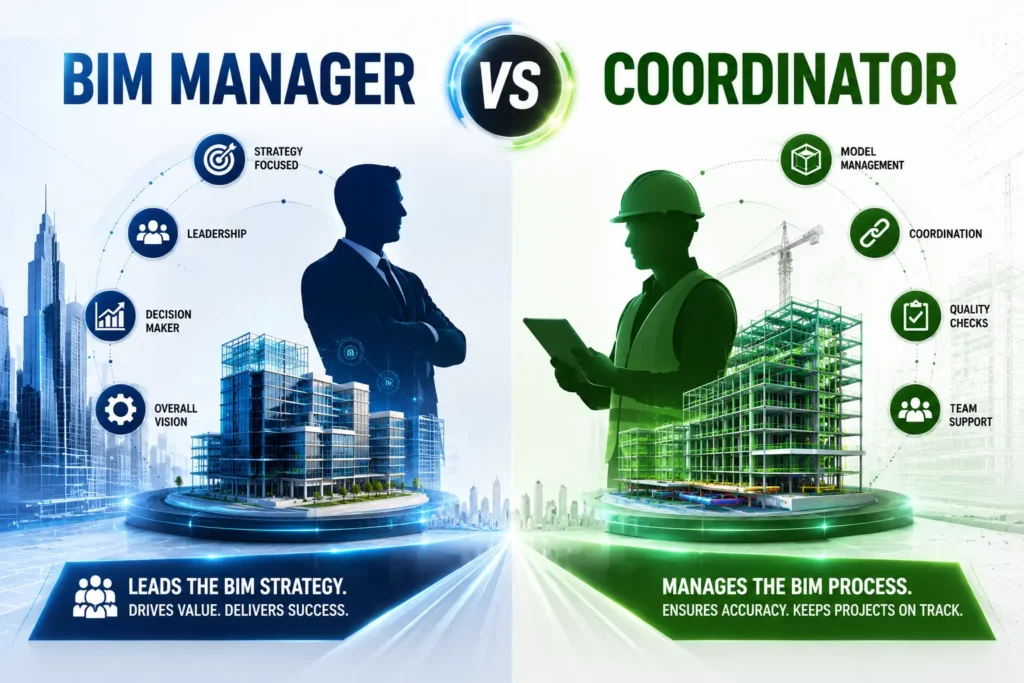
BIM Coordinator: Making Sure Everything Fits Together
A BIM Coordinator sits above individual model authors, responsible for making sure the architectural, structural, and MEP models actually work together without clashing — and that the whole team follows a consistent BIM process.
What a BIM Coordinator Actually Does
- Runs clash detection between disciplines using tools like Navisworks
- Reviews models from different teams for consistency and coordination issues
- Manages the Common Data Environment — file structure, permissions, version control
- Facilitates coordination meetings between architecture, structural, and MEP teams
- Ensures models meet the LOD and BIM Execution Plan (BEP) requirements for each project stage
Skills Required
- Everything a BIM Author knows, plus strong clash detection and Navisworks skills
- Understanding of BIM Execution Plans and how to enforce them across a project team
- Communication skills — coordinators spend real time explaining issues to designers from other disciplines
- Familiarity with ISO 19650 or similar information management standards
Coordinators typically have a few years of hands-on modeling experience before moving into this role — you can’t effectively coordinate a process you haven’t done yourself.
BIM Manager: Owning the BIM Strategy for the Whole Project (or Firm)
A BIM Manager operates at a strategic level — setting up the BIM Execution Plan itself, deciding software standards, training teams, and often managing BIM implementation across multiple projects or an entire firm.
What a BIM Manager Actually Does
- Writes and owns the BIM Execution Plan for new projects
- Sets modeling standards, templates, and family libraries used firm-wide
- Selects and manages BIM software, CDE platforms, and related technology decisions
- Trains and mentors BIM Authors and Coordinators
- Reports BIM progress and value to senior management and clients
- Ensures compliance with international standards (ISO 19650) on larger or export-facing projects
Skills Required
- Deep, broad BIM knowledge across multiple disciplines and software platforms
- Project management and leadership skills — this role manages people, not just models
- Strong understanding of ISO 19650, BEP structure, and information management principles
- Business awareness — BIM Managers often justify BIM investment and ROI to leadership
This is a senior role, typically reached after several years working as a Coordinator, sometimes combined with broader project management experience.
BIM Manager vs Coordinator : Comparison at a Glance
Role | Focus | Typical Experience | Key Tools |
BIM Author | Building the model | Entry-level to 2 years | Revit, Civil 3D, Tekla |
BIM Coordinator | Cross-discipline coordination | 2-5 years | Navisworks, BIM Collaborate Pro |
BIM Manager | Strategy and standards | 5+ years | BEP frameworks, ISO 19650, multiple platforms |
The Typical Career Path
Most BIM professionals move through these roles in sequence rather than jumping straight to a senior position:
- Start as a BIM Author, building strong modeling fundamentals in Revit or a discipline-specific tool
- Move into a BIM Coordinator role once you understand modeling well enough to spot and resolve cross-discipline issues
- Progress to BIM Manager after gaining coordination experience across multiple projects, often supplemented with project management training
This progression usually takes several years, but the timeline varies a lot based on project exposure — professionals who get hands-on coordination experience early tend to move faster than those who stay purely in modeling roles.
Which Path Should You Choose?
If you enjoy hands-on 3D modeling and want to specialize deeply in a discipline (architecture, structure, or MEP), staying focused as a BIM Author with growing expertise can be a genuinely rewarding long-term path — senior BIM Authors are valued for their modeling precision.
If you like problem-solving across teams and don’t mind the coordination workload of chasing down clashes and inconsistencies, the Coordinator path offers faster growth and broader project exposure.
If you’re drawn to leadership, standards-setting, and the business side of BIM adoption, aim toward the Manager path — but expect to build real Coordinator experience first, since BIM Managers need to understand the coordination process deeply to lead it effectively.
Building the Foundation for Any of These Paths
Regardless of which path you’re aiming for, the starting point is the same: solid, hands-on BIM modeling skills across the software your target industry actually uses — Revit, Navisworks, and a working understanding of BIM Execution Plans and coordination workflows.
Frequently Asked Questions
A: A relevant engineering or architecture background helps significantly, but the specific requirement depends on the discipline — architects typically move into architectural BIM Authoring, while civil/structural engineers move into structural BIM roles.
A: It’s uncommon and generally not recommended — effective coordination requires understanding modeling well enough to judge what’s realistic to fix and why clashes happen in the first place.
A: BIM Managers focus primarily on strategy, standards, and team leadership rather than day-to-day modeling, though many retain strong technical skills from their earlier career stages.
A: Most professionals reach a Coordinator role after 2-5 years of hands-on BIM Authoring experience, though this varies based on project complexity and coordination exposure.
A: Start with Revit (or Civil 3D/Tekla for structural work) to build modeling fundamentals, then add Navisworks for clash detection and coordination skills as you progress.
A: Both — as Hyderabad’s construction and infrastructure sector grows, more local firms and multinational companies operating here are creating dedicated BIM Manager positions, alongside continued demand for Coordinators and Authors.
A: CAD Center Hyderabad’s BIM training covers Revit, Navisworks, and BIM Execution Plan fundamentals — the same foundation this career path builds on, with hands-on, project-based learning at our Ameerpet campus.
A: Course fees vary depending on batch and mode (online/offline). Contact us for exact pricing for your preferred schedule.
Start Building Your BIM Career Path
Whether you’re aiming to become a BIM Author, Coordinator, or eventually a BIM Manager, it starts with the same solid foundation — hands-on modeling and coordination skills built through real project practice.
Visit us: Ameerpet, Hyderabad — [Get Directions]
See what our students say — [Google Reviews]
Prefer to learn from home? Live online batches are also available for students outside Hyderabad.