
Beyond the 3D Model — How Buildings Get a Live, Data-Connected Twin
“Digital twin” is one of those terms that gets used constantly in BIM and construction-tech conversations, often without a clear explanation of what actually separates it from a regular BIM model. If you’ve seen the term mentioned alongside IoT, smart buildings, or facility management and want an actual explanation — not just buzzwords — this guide covers it properly.
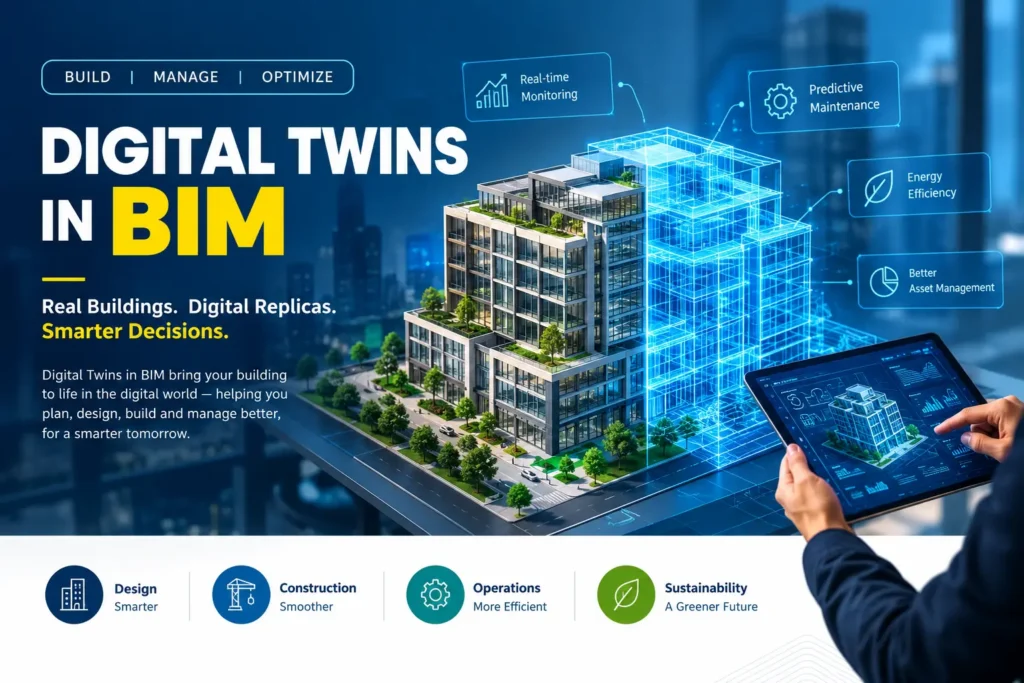
What Is a Digital Twin?
A digital twin is a live, continuously updated virtual replica of a physical building or asset, connected to real-world data through sensors, IoT devices, and operational systems. Unlike a standard BIM model — which represents a building accurately at a point in time (usually at design or handover) — a digital twin stays synchronized with the real building as it operates: tracking things like temperature, occupancy, equipment performance, and energy use in real time.
The simplest way to understand the difference: a BIM model is a highly detailed snapshot. A digital twin is that same model, kept alive with a continuous data feed from the real building.
How a Digital Twin Is Different from a Regular BIM Model
A BIM model built during design and construction typically becomes less accurate over time — spaces get used differently than planned, equipment gets replaced, and small changes accumulate that the original model never captures. A digital twin solves this by staying connected to the physical asset after handover, rather than being treated as a finished deliverable.
This distinction matters in practice:
- A BIM model answers: “What was designed and built?”
- A digital twin answers: “What is happening in this building righnt ow?”
How Digital Twins Are Built: From BIM Model to Live Twin
Creating a genuine digital twin generally follows a maturity progression:
- Digital Model — A detailed BIM model exists, but with no automatic connection to the physical asset. Any updates are manual.
- Digital Shadow — Data flows automatically from the physical asset to the digital model (sensor readings update the model), but changes don’t flow back the other way.
- Digital Twin — Data flows in both directions: the model reflects real-world conditions, and insights or controls from the model can influence the physical asset (like adjusting HVAC settings based on occupancy data).
Most buildings today, even sophisticated ones, sit somewhere between a digital shadow and a true digital twin — full bidirectional integration is still relatively rare outside flagship smart-building and smart-city projects.
What Digital Twins Are Actually Used For
Predictive Maintenance
Instead of fixing equipment after it fails, sensor data feeding into the digital twin can flag unusual patterns (vibration, temperature, energy draw) that indicate a problem before a breakdown occurs.
Space Utilization and Energy Optimization
Real-time occupancy and environmental data lets facility managers see exactly how spaces are actually used, enabling smarter decisions about lighting, HVAC scheduling, and space planning than static assumptions ever could.
Lifecycle Asset Management
Every piece of equipment in the model carries real operational history — installation date, maintenance records, performance trends — turning the model into a genuinely useful long-term asset register, not just a design artifact.
Disaster and Risk Planning
At a larger scale, city-level digital twins (like Virtual Singapore) are used to simulate scenarios — flooding, traffic disruption, infrastructure failure — helping planners test responses before a real event happens.
The Role of LOD and BIM Levels in Enabling Digital Twins
A digital twin is only as good as the underlying model data. This is where concepts like LOD (Level of Development) and BIM maturity levels directly matter: a digital twin generally requires LOD 500 — fully verified, as-built model data — since predictive maintenance and asset management depend on the model accurately reflecting what was actually built and installed, not just what was designed.
Similarly, digital twin capability is closely associated with BIM Level 3 maturity — the stage where teams work from a single, real-time shared model with deep system integration, rather than siloed, static files.
Why This Matters for Your BIM Career
Understanding digital twins isn’t just theoretical knowledge for a growing part of the BIM job market. As more large-scale projects — particularly government infrastructure and smart-city initiatives in India — move toward digital-twin-ready deliverables, BIM professionals who understand how model data needs to be structured to support a digital twin (accurate LOD, embedded asset data, IoT-ready metadata) have a genuine edge over those who only know how to model geometry.
This is increasingly reflected in how BIM Execution Plans are being written, with some projects now specifying “digital twin–focused” requirements that go beyond traditional design and construction deliverables.
Is India Ready for Digital Twins? A Realistic View
Full digital twin implementation remains more common in mature markets and flagship projects globally than in typical Indian construction projects today. However, large infrastructure and smart-city initiatives — the kind increasingly common in Hyderabad’s growth corridor — are actively building toward this capability, and demand for professionals who understand both BIM fundamentals and the data requirements behind digital twins is rising accordingly.
Frequently Asked Questions
A: No. A BIM model is a detailed 3D representation, typically most accurate around design and handover. A digital twin goes further, maintaining a live, continuously updated connection to the real building through sensors and data feeds.
A: Digital twin capability typically builds on strong BIM fundamentals (Revit, Navisworks, structured data management) combined with an understanding of how that data integrates with IoT and facility management platforms — not a completely separate skill set.
A: Digital twins generally require LOD 500 — fully verified, as-built data — since the model needs to accurately reflect what was actually constructed and installed to support reliable predictive maintenance and asset management.
A: Large infrastructure and smart-city projects are the most visible current use cases, but the underlying principles (accurate as-built data, structured asset information) are increasingly relevant across commercial and institutional buildings too.
A: BIM Level 3 describes a team’s ability to work from a single, real-time shared model with deep integration — the same collaborative maturity that digital twin implementation depends on.
A: It’s an emerging expectation, particularly for roles on government infrastructure and smart-city projects. Understanding the concept — and how proper BIM data practices support it — is increasingly seen as a sign of broader professional maturity in BIM.
A: CAD Center Hyderabad’s BIM training covers the Revit, Navisworks, and data-management fundamentals that underpin digital twin-ready modeling — with hands-on, project-based learning at our Ameerpet campus.
A: Course fees vary depending on batch and mode (online/offline). Contact us for exact pricing for your preferred schedule.
Build the BIM Foundation Digital Twins Are Built On
Digital twins start with strong BIM fundamentals — accurate modeling, structured data, and real coordination experience. Our hands-on BIM course in Ameerpet, Hyderabad builds exactly that foundation.